Nvidia’s Groq 3 LPU: The Inference Coprocessor That Could Reshape AI Server Architecture
For years, the AI infrastructure conversation has revolved around a familiar question: how many GPUs can a data center deploy? Nvidia’s Groq 3 LPU suggests that the next question may be more interesting: which parts of an AI workload should actually run on those GPUs?
The distinction matters. Training a model, processing a long prompt, and generating the next token are related tasks, but they do not place identical demands on silicon. Treating them as one workload can leave expensive hardware making compromises between throughput, memory capacity, and responsiveness.
Nvidia’s answer is not to push the GPU aside. It is to give it a specialized partner. The Groq 3 language processing unit is the chip; Groq 3 LPX is the rack-scale system built around it. Together with Vera Rubin GPUs, the platform introduces a more finely divided inference pipeline: GPUs retain prefill and decode attention, while LPUs accelerate latency-sensitive feed-forward and mixture-of-experts execution. This is cooperation within token generation, not simply a handoff from one processor to another.
That makes the LPU more than another accelerator announcement. It offers a glimpse of an AI server architecture organized around the anatomy of inference itself.
Why Inference Needs More Than Bigger GPUs
Large language model inference has two major phases. During prefill, the system processes the input prompt and builds the key-value cache, or KV cache, used in subsequent attention calculations. A long document or conversation provides substantial parallel work, giving powerful GPUs room to operate efficiently.
Decode is different. The model generates output through a repeated sequence of dependent steps. Each new token extends the context for the next step, making latency inside that loop important.
Batching can improve efficiency by combining requests from multiple users. But waiting to assemble a batch, or allowing throughput-oriented work to dominate scheduling, can conflict with the responsiveness an interactive application needs.
This is the tension behind the LPU. A service can report impressive aggregate token production while individual users experience sluggish responses. Conversely, delivering exceptionally fast responses to a small number of users can leave a large accelerator underutilized.
The useful question is therefore not whether GPUs are “good” or “bad” at inference. It is whether one execution engine should carry every part of a workload whose bottlenecks change within each request.
The Architecture: Predictability Before Peak Arithmetic

The Groq 3 LPU takes a different approach from a broadly programmable GPU. Its design emphasizes explicit data movement, high on-chip memory bandwidth, and compiler-orchestrated execution.
Each chip contains 500 MB of SRAM and offers a stated 150 TB/s of on-chip SRAM bandwidth. Compute and communication operate around 320-byte vectors, with specialized modules handling matrix arithmetic, vector operations, and structured data movement.
The central idea is determinism. Rather than depending primarily on dynamic hardware decisions to discover when operations and transfers should happen, the compiler schedules computation, movement, and synchronization in advance.
That does not make an entire AI service immune to delays. Requests still arrive unpredictably, queues still form, and software still has work to do. It does, however, aim to make the accelerator’s execution behavior more predictable once work has been mapped onto it.
For interactive inference, consistency can matter almost as much as speed. A fast average response means little if occasional stalls break a voice conversation or repeatedly interrupt an agent’s workflow.
SRAM Is the Advantage—and the Constraint
The memory story deserves careful attention because it explains both the LPU’s appeal and its limitations.
On-chip SRAM provides extremely fast access to an explicitly managed working set. Keeping latency-sensitive data close to execution units reduces dependence on repeated off-chip transfers and unpredictable memory stalls.
But SRAM is not a bottomless substitute for high-bandwidth memory. Its capacity consumes silicon area, and 500 MB on one chip cannot hold every large model and its expanding context state.
Groq 3 LPX addresses this through scale-out across tightly connected processors. A rack contains 256 LPUs, providing 128 GB of aggregate SRAM. Larger working sets can be partitioned across chips, with the compiler coordinating execution and transfers.
Even then, aggregate capacity should not be confused with one physically unified memory pool. Placement, partitioning, communication, and workload structure determine how effectively that SRAM can be used.
Nor does the architecture eliminate external memory throughout the system. LPX includes DDR5 resources, while the companion GPUs retain the memory capacity needed for context-heavy processing. The real proposition is memory specialization: use SRAM where fast, predictable access delivers the greatest benefit, and keep capacity-oriented work on the appropriate engine.
The Important Split Happens Inside Decode

The tempting explanation is simple: GPUs process prompts, then LPUs generate answers. Unfortunately, it misses the most consequential feature.
In Nvidia’s described architecture, GPUs continue participating throughout decode. They handle attention over the accumulated KV cache. LPUs accelerate feed-forward networks, including expert execution in mixture-of-experts models, and other latency-sensitive operations.
This arrangement is called attention–FFN disaggregation. Intermediate activations move between the GPU and LPU portions of the pipeline as token generation proceeds.
The division follows the workload. Long-context attention needs substantial memory capacity and efficient access to growing state. Small-batch feed-forward execution can benefit from the LPU’s high-bandwidth, predictable execution path.
But there is no free lunch. Every handoff introduces communication and orchestration costs. Splitting a layer is worthwhile only when the execution savings exceed those costs.
Consequently, the strongest case for LPX is not “specialized silicon always wins.” It is that selected models and latency targets may justify a carefully engineered two-engine loop.
The Rack Becomes Part of the Processor
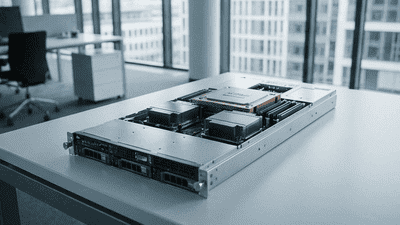
A single LPU does not tell the whole story. LPX is designed as a coordinated rack-scale system, with 32 liquid-cooled compute trays containing eight LPUs each.
Nvidia specifies 640 TB/s of aggregate scale-up bandwidth across the rack. That figure describes the internal communication fabric, not a universal application throughput number or a promise about external networking performance.
The distinction matters because distributed inference depends on timely coordination. An accelerator waiting for another chip’s output cannot turn theoretical memory bandwidth into useful token generation.
LPX therefore treats communication as something to schedule alongside arithmetic. The compiler overlaps transfers and computation, while chip-to-chip synchronization helps the interconnected LPUs behave as a coordinated execution system.
This pushes server design beyond selecting a processor and adding memory. Compute trays, interconnect topology, cooling, and software placement become integral to performance. The meaningful product is the execution fabric, not merely the die.
Software Decides Whether the Hardware Pays Off
Heterogeneous hardware creates options. It also creates operational complexity.
A serving platform must decide where requests belong, preserve useful cached state, schedule work against latency targets, and move intermediate activations without allowing communication to dominate the request.
Nvidia positions Dynamo as the orchestration layer for this process. It coordinates GPU prefill and the repeated attention–FFN decode loop across GPU and LPU backends.
This is where architectural elegance meets production reality. Traffic arrives in bursts. Context lengths vary. Some users generate short answers; others launch long reasoning tasks. Multiple models may compete for resources.
The compiler must also map models effectively onto the LPU fabric. New operators, model revisions, and changing execution patterns can alter that mapping. Predictability is valuable, but maintaining it requires capable tooling.
For operators, the deployment question is therefore broader than chip performance. How much engineering effort does the system require, and how quickly can it adapt when the model portfolio changes?
A Second Role: Accelerating Speculative Decoding
The LPU also has a potential role as a fast draft-generation engine.
Speculative decoding uses a smaller model to propose multiple candidate tokens. A larger target model then verifies those candidates, accepting matching sequences and correcting rejected proposals.
In a heterogeneous implementation, LPUs can generate drafts while GPUs perform verification. This pairs low-latency generation with the GPU’s ability to process verification work efficiently.
The benefit depends on more than draft speed. Acceptance rates, coordination overhead, and the cost of running the additional model all affect the outcome.
A blazing-fast draft engine that proposes too many rejected tokens may accomplish little. A well-matched draft model, however, can make the LPU useful without assigning it the entire target model’s inference workload.
Where GPU, ASIC, and NPU Labels Stop Helping
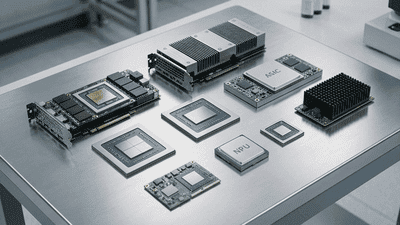
AI hardware debates often sound like a contest among GPU, ASIC, and NPU categories. The Groq 3 LPU shows why those labels can obscure the useful comparison.
A GPU offers broad programmability and supports training, inference, and other parallel workloads. A specialized AI accelerator targets a narrower set of operations or execution patterns. “NPU” describes a broad family of neural-network processors rather than one consistent server architecture.
The LPU’s distinguishing feature is not simply specialization. It is the combination of SRAM-first working storage, scheduled data movement, and coordinated execution across many chips.
Those choices should be assessed against specific workloads. An accelerator optimized for low-latency language generation need not be the best destination for training, embeddings, media processing, or heavily batched background inference.
The likely architectural shift is therefore not toward one winning acronym. It is toward assigning different operations to processors with complementary strengths.
The Economics: Measure Useful Work, Not Just Tokens
For infrastructure buyers, faster generation matters only when it improves the economics of the service.
The relevant comparison includes the added LPU rack, companion GPU capacity, networking, cooling, software integration, and utilization. Low latency has value, but that value must cover the resources used to deliver it.
Headline performance multipliers also need context. Nvidia’s published comparisons describe selected combined-platform operating points, including large mixture-of-experts models and demanding interactivity targets. They should not be interpreted as universal gains attributable to the LPU alone.
A more useful evaluation would track several measures together:
- Time to first token and time between subsequent tokens.
- Tail latency under realistic concurrency and bursty traffic.
- Throughput while meeting the required response-time target.
- Total energy and capital cost across both execution engines.
- Completed tasks at a consistent model quality and service level.
For coding agents or multi-step assistants, completed tasks may be especially revealing. Faster generation can shorten repeated reasoning loops, but tool execution, retrieval, and external services can still dominate the overall workflow.
What This Could Mean for the Semiconductor Supply Chain
LPX also changes how the opportunity should be viewed across the hardware ecosystem.
SRAM-heavy processors place value on a different memory arrangement from HBM-centered GPU systems. Yet a complementary GPU–LPU deployment does not automatically reduce total HBM demand. More capable services could increase GPU usage even as selected operations migrate to LPUs.
Similarly, adding a second execution fabric broadens the importance of liquid cooling, rack integration, high-speed connectivity, power delivery, and systems engineering.
These are architectural implications, not guaranteed revenue forecasts. Supplier exposure depends on actual deployments, component sourcing, pricing, and how many LPU resources operators need relative to GPU capacity.
For semiconductor analysis, the key variable becomes the system bill of materials per economically useful inference workload—not simply accelerator shipments or peak compute growth.
A Complement, Not a Coronation
The Groq 3 LPU’s most important contribution may be conceptual: it makes the case for dividing inference more precisely than “training hardware” versus “inference hardware.”
Within inference, prefill, attention, feed-forward execution, draft generation, and verification can demand different combinations of compute, memory, and timing behavior.
Whether LPX becomes a major architectural building block will depend on production results: reliable latency, manageable software complexity, strong utilization, and favorable economics across meaningful workloads.
But the direction is compelling. The future AI server may not be defined by the biggest accelerator doing everything. It may be defined by several engines, each doing less—and together delivering more.